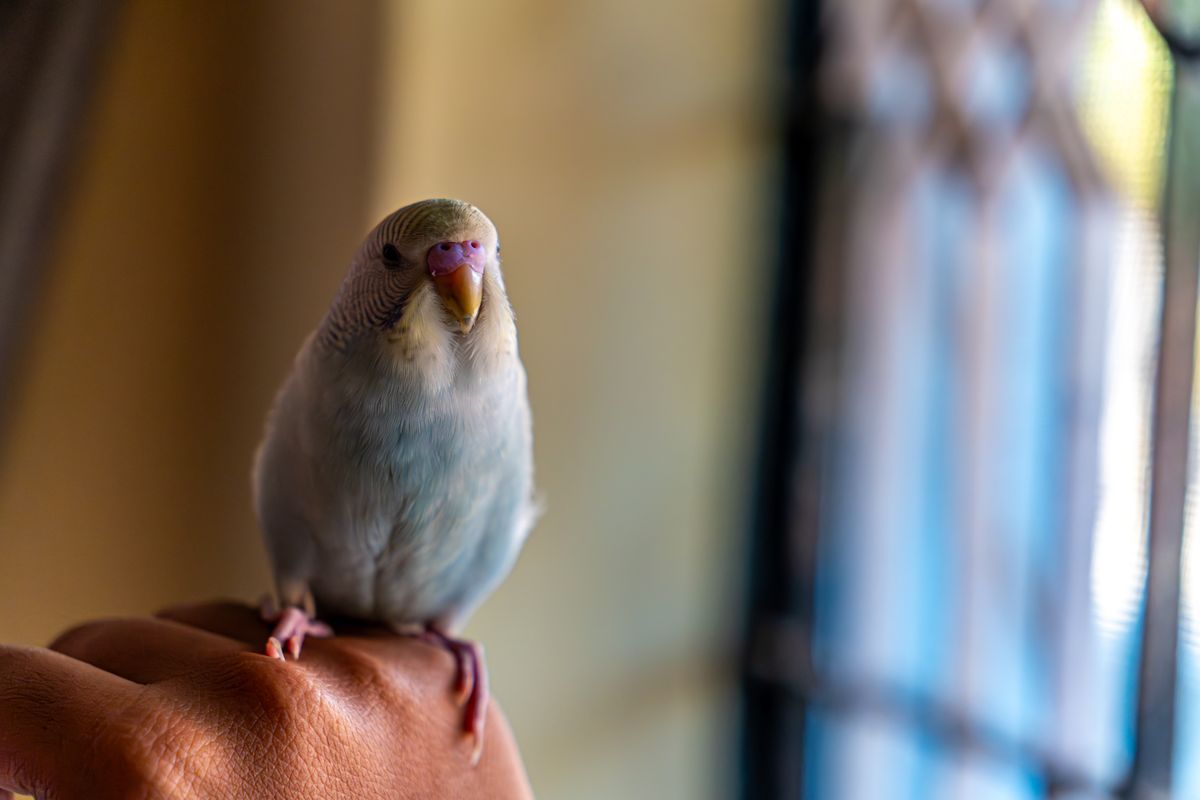
A tame budgie that hops onto your finger is a joy. Most budgies can learn to trust people, but it takes patience and small steps. Rushing usually backfires. This guide explains how to tame a budgie and hand-train it, even if your bird is nervous.
Quick Answer: Let your budgie settle for a few days, then spend time near the cage talking softly. Offer millet through the bars, then inside the cage, then from your hand. Once your budgie eats from your hand, gently press a finger against its lower belly and say “step up.” Keep sessions short, about 5 to 10 minutes, a few times a day.
Before You Start
- Give your budgie time to settle. For the first 3 to 7 days, keep things quiet and avoid reaching into the cage except to change food and water.
- Learn body language. A relaxed budgie has smooth feathers, chirps and preens. A scared budgie is thin and tall, flutters or breathes fast.
- Pick a training treat. Spray millet is the favorite for most budgies. Reserve it for training.
- Keep sessions short and positive.
Step-by-Step Taming Plan
Step 1: Be a calm presence
Sit near the cage and talk, read aloud or sing softly. Do this several times a day so your budgie learns you’re not a threat.
Step 2: Offer millet through the bars
Hold a sprig of millet against the bars. Wait patiently. When your budgie nibbles, stay still.
Step 3: Move your hand into the cage
Slowly place your hand inside the cage, resting it near a perch without moving toward your bird. Do this until your budgie ignores your hand.
Step 4: Hand-feed inside the cage
Hold millet in your hand inside the cage so your budgie must come closer to eat. Over several sessions, hold the millet closer to your fingers.
Step 5: Teach “step up”
- Hold your index finger horizontally just above your budgie’s feet, against the lower belly.
- Apply gentle pressure and say “step up.”
- Most budgies naturally step on to keep their balance.
- Reward with praise and a taste of millet.
Step 6: Practice and build trust
Repeat step-up a few times per session. Then try moving your hand slightly while your budgie is perched.
Step 7: Out-of-cage time
Once your budgie steps up reliably inside the cage, practice in a safe, bird-proofed room. Many people start in a small room like a bathroom with the toilet lid closed and mirrors covered.
Typical Taming Timeline
| Stage | Typical time |
|---|---|
| Settling in | 3–7 days |
| Eating near you | 1–2 weeks |
| Eating from your hand | 2–4 weeks |
| Stepping up | 3–6 weeks |
| Comfortable out of the cage | 1–3 months |
Every budgie is different. Young, hand-fed budgies may tame within days. Older or wild-type birds can take months.
Tips for Shy or Older Budgies
- Move even more slowly and celebrate small wins.
- Train when your budgie is naturally hungry, such as in the morning before fresh food is added. Never withhold food to force training.
- Keep the cage at chest height, not too high.
- Try target training, teaching your bird to touch a chopstick for a reward.
Common Mistakes
| Mistake | Why it hurts trust |
|---|---|
| Grabbing your budgie | Feels like a predator attack |
| Chasing it around the cage | Causes panic and possible injury |
| Long sessions | Budgies get tired and stressed |
| Training right after a scare | Your bird can’t focus |
| Too many people at once | Overwhelming for a new bird |
Single vs. Paired Budgies
Single budgies often tame faster because they look to you for company. Paired budgies can still become tame, but may take longer and prefer each other. Train each bird separately for short periods.
Safety Basics for Out-of-Cage Time
- Close windows and doors.
- Turn off ceiling fans.
- Keep cats and dogs out of the room.
- Avoid cooking with nonstick pans. See household hazards for pet birds.
When to Call Your Vet
Taming can be harder if your budgie doesn’t feel well. Call your avian vet if your budgie:
- Is fluffed up and quiet
- Isn’t eating
- Has changes in droppings
See signs your bird is sick and our budgie care guide.
Frequently Asked Questions
Should I clip my budgie’s wings to tame it?
Many avian experts now prefer leaving budgies flighted when the home can be made safe, as flight is important for exercise and confidence. Discuss pros and cons with your vet.
Why does my budgie bite?
Budgies may nip when scared, hormonal or when they don’t want to step up. Watch body language and back off before your bird feels it needs to bite.
Can I tame a budgie that lives with another budgie?
Yes. It may just take a little longer. Short one-on-one sessions help.
How do I get my budgie back in the cage?
Use the step-up cue, a favorite treat or place fresh food in the cage. Avoid chasing.
Will my budgie learn to talk once tamed?
Many tame budgies, especially males, start mimicking words they hear often. Repeat short phrases clearly during calm, happy moments.
This article is for general information only and isn’t a substitute for professional veterinary advice. If you’re worried about your pet’s health, contact your veterinarian or an emergency animal hospital.